
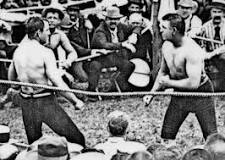
Matthias Clark stepped into the ring formed by thirty to forty people in a small village in Ireland hoping to see the challenger stop the unofficial bare-knuckle boxing champion of the region once and for all. John, the brother of the swarthy fighter, who also acted as his second, was the barker in this carnival-like setting, promoting Matthias’ prowess as undefeatable and as brutal a man as the area had ever known by the mid-nineteenth century. John would take all the bets and hold all the money as he had many times before daring the biggest, boldest local opponent to take on the fearsome Mr. Clark.
As in many previous occasions, Matthias would absorb a few blows to the body and make the match appear interesting while John cried out to the swelling crowd to put their money in his hat so they might be assured of their two-to-one return (as the competition and betting increased in intensity) when, hopefully, Clark would hit the ground, stay down and be declared the loser. By the time John’s hat was full to the brim with cash, brother Matthias slowly but surely came alive as if getting his second wind and landed a fierce knock to the temple of the newcomer who went down for the count. Only this time was different. The challenger didn’t get up. He was dead.
Since this was not a legally sanctioned fight (as many were not in those days), and as the local populace quickly realized that they had been hustled out of their hard-earned wages, there was going to be hell to pay when the Clark brothers hightailed it out of town leaving the local hero to be buried by his grieving family. The daring duo, not wanting to face charges of manslaughter, for which one or both men might hang, with their wives, boarded a ship headed to the New World. Avoiding New York because so many Irish immigrants there might increase the odds of running into someone who would know them, they opted to go down the coast to a lesser-known area but which still offered an Irish expatriate community. Savannah, Georgia, had become the hub of Irish immigration in the South when some 2,300 souls had moved there by 1861 to escape the great Potato Famine.
The Irish are known for their deep roots in boxing history. The “Irish stand down” is a type of traditional bare-knuckle fighting where the aspect of maneuvering around the ring is removed, leaving only the less nuanced aspects of punching and “taking” punches. This form of combat was popular in Irish American ghettos in the late 1800s (remember the movie Far and Away?). The Clarks, proficient in this style, hadn’t yet learned their lesson and soon began to hustle the same type of back alley matches that had filled their pockets so well before. But once again, Matthias either didn’t know his own strength or just couldn’t help himself and one fateful afternoon, killed another challenger with a mighty blow to the head. This time, in a heap of trouble, the Clark boys headed off to a place so remote that no one could find them, deep in the Ozark Mountains of southern Missouri.
There are a couple reasons this account has any relevance to us, 1) John Clark was Esa’s great grandfather on her mother’s side, Matthias being the great uncle, and 2) it confirms the power of God to intervene in the affairs of men and rescue a lost young woman from a most unlikely line of predecessors. A little over a year ago, after attending the funeral of Esa’s mother, we made a lengthy trek into some of the most rugged Ozark wilderness, where the population is still so extremely thin it hasn’t grown in decades, to the Clark Cemetery, where both John and Matthias are buried. Established in 1913, the cemetery has many of their descendants buried there and where Esa and I have side-by-side plots reserved for whenever our times come for our remains to occupy them.
The isolated graveyard, an acre in size, is surrounded by hundreds of square miles of tall pine and hardwood trees, gorgeous spring-fed rivers, majestic bluffs, high hills, deep hollers and gravel roads that seem to go nowhere. Part of this was purchased 150 years ago for the Clark family homestead. Its address is simply Midridge, Missouri, which isn’t even a town after its post office closed sixty years ago, in the poorest county in the state, and one of the most secluded and hard-to-reach areas anywhere. It’s where Esa grew up. It’s eerily beautiful. And lonesome. A great place to be from.
In my testimony, I’ve spoken of our violent marriage before we met Jesus. Esa, quite small as a teenager, had learned to fight with her fists and had earned the reputation as being the toughest girl in those parts which were known for audacious, aggressive women who fought by biting, clawing and hair-pulling. After a string of skirmishes provoked by taunts and insults, Esa was finally forced into a fight with the biggest, meanest girl in school, whom she dropped with a sharp right hook to the jaw. It was as if the girl brought a knife to a gunfight. There were no more challenges after that. I didn’t know about any of this until way too late in our relationship. So when we got into a heated argument that escalated to the physical, I found out I had a tiger by the tail. I once asked a former school chum about Esa’s history and he hesitantly told me, “You know, as far as I ever heard, she never started a fight,” he said. “but boy, she sure ended a few.” Now, looking back down the family tree, I realize where all that rage and ferocity came from. It’s kind of funny now, but it wasn’t funny at all back then!
This all reminds me of the Genesis 38 account of Judah, when he slept with a young woman who disguised herself and pretended to be a prostitute. Then, three months later, he discovered that she was his daughter-in-law and pregnant to boot. Judah had promised Tamar, the daughter-in-law, that his third-born son would marry her after the deaths of her first and second husbands, but he reneged. Judah’s first and second-born sons were both killed by the Lord for their wicked ways. So Tamar tricked Judah because he had failed to keep his promise to redeem her from widowhood, which was the custom. Judah was exposed and publicly shamed. Both Judah and Tamar appeared to be conniving characters in a widely dysfunctional family. What a mess. Could any good come from this? Turns out, the family line was preserved in Tamar who is the first woman listed in the genealogy of Christ!
The details of the narrative of the lives of John and Matthias Clark are of course lost to posterity and are probably even more intriguing than what we now know. Michael, a respected businessman, and chairman of the cemetery board, sat across from us at the post-funeral dinner and told us the history of the cemetery and the entire area including the chronicles of the Clark brothers of Ireland. We were fascinated. Esa says today, “Who knows what those guys must have gotten into and what their later lives were like in the Ozarks? But now I know about my distant forefather and uncle. I have no idea where he was with the Lord, but I do know where I am, safe in the arms of Jesus. And that’s my story and I’m stickin’ with it.”

Terry Everroad

Esa Everroad
 lionsheadcafe.com